
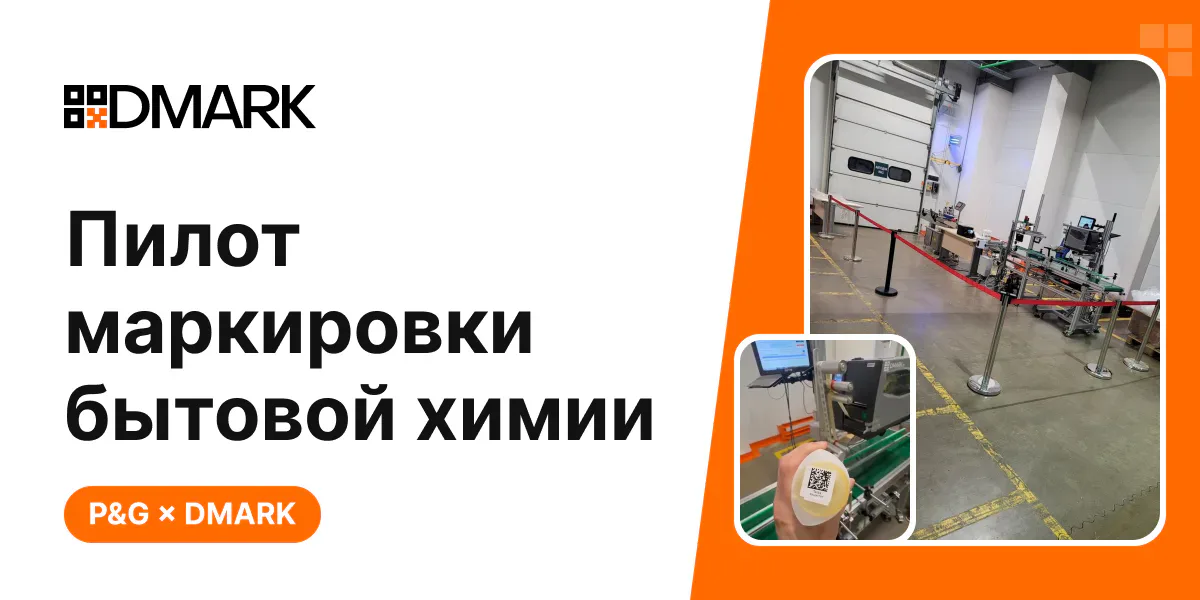
Household Chemicals Labeling Pilot: How DMARK Labeled P&G Products at the Apple City Warehouse
As part of the state pilot for labeling household chemicals and cosmetics, DMARK deployed two working lines for P&G products at the Apple City warehouse: an automatic print-and-apply labeler on the conveyor and a manual station with a scanner and desktop printer. Here's what it looked like.
From July 1, 2025 to June 30, 2026, a pilot project on digital marking of household chemicals and cosmetics was running in Kazakhstan. It was organized by the Ministry of Industry and Construction, and Kazakhtelecom — the operator of the national marking system IS MPT — acted as the operator. Twenty organizations took part in the pilot: domestic manufacturers, importers, and wholesale and retail companies. Among them was also the distributor of Procter & Gamble in Kazakhstan.
The pilot tested the entire cycle: issuing codes, applying them to products, aggregation, and withdrawal of goods from circulation via the cash register. Soap, detergents and cleaning products, decorative cosmetics, and hair and oral care products fell under the marking requirement.
The DMARK team was responsible for the practical part — applying DataMatrix codes to P&G products directly at the Apple City warehouse.
Task: mark imported goods at the warehouse
Imported goods arrive already in factory packaging, which has no marking code. This means the code must be applied at the warehouse — before the goods enter circulation. Moreover, it must be applied to various products: shampoos in bottles, deodorants, and other items with different packaging shapes and sizes.
Therefore, instead of a single universal solution, we set up two workstations at the warehouse for different scenarios.
Line 1: print-and-apply machine on the conveyor
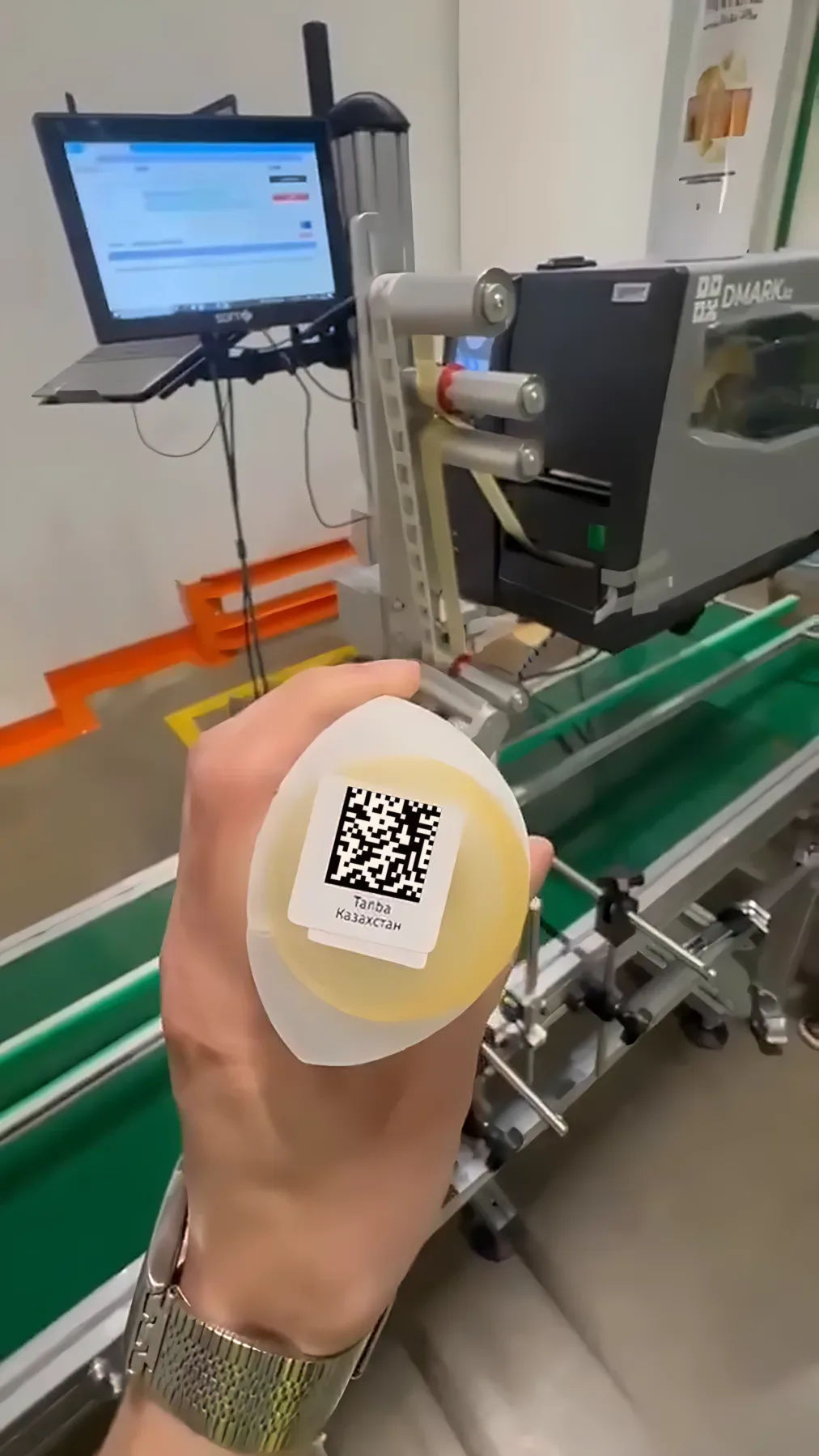
The first section is an automated line. The product moves along the conveyor, the DMARK print-and-apply machine prints a label with a unique DataMatrix code and immediately applies it to the packaging. Above the conveyor is a signal tower and a camera, and next to it is an operator monitor running the DMARK software, which shows which codes have been printed and applied.
This station is suitable for a flow of identical products: the operator only needs to feed the products onto the conveyor and remove the already marked units.
Line 2: Manual Station with a Scanner
The second station is for items that are inconvenient to run through the conveyor, and for small batches. The operator scans the product's barcode with a handheld scanner, the DMARK software selects the required marking code, a desktop label printer immediately prints a label with a DataMatrix code, and the operator applies it to the packaging. Next to it stands a semi-automatic labeller for products that can be marked in-line.
The entire setup — scanner, printer, and laptop with the DMARK software — fits on a single desk and can be deployed without reconfiguring the warehouse.
What the pilot showed
The main takeaway for importers is that marking can be integrated into the operations of an existing warehouse: without stopping receiving and shipping and without reconfiguring the premises. The code is printed and applied on site, and data on the applied codes immediately goes into the software.
The second takeaway is that there is no single solution for all goods. For a flow of identical products, a conveyor with a print-and-apply system is more advantageous; for individual items and small batches, a manual station with a scanner. Both options can operate smoothly in the same warehouse.
What DMARK offers
DMARK is a Kazakhstani company that develops labeling software and selects the hardware to go with it: printers, applicators, cameras, scanners, and conveyor solutions. Household chemicals and cosmetics are one of our focus areas, and we apply the experience from this pilot in deployments for manufacturers and importers.
Our approach is the same as always: first we look at how your warehouse or production facility is organized and which goods need labeling and in what volume, and only then do we propose a configuration.
Preparing to label household chemicals and cosmetics?
Tell us what you import or manufacture and in what volumes — we will select a solution for your warehouse and show you how it works on live equipment.