
How DataMatrix Works — A Risk for Business?
We break down DataMatrix piece by piece: what is encoded inside the code, why it was chosen for marking around the world, and what is in store for businesses in Kazakhstan if this requirement is ignored.
In our previous article, we took a run through the history: from the first sale by barcode to QR codes in Kaspi. And at the end we briefly touched on DataMatrix. That very same square code you see on a box of medicine, on a pack of cigarettes, on the tag of a pair of sneakers. A code into which governments around the world decided to embed information about every single product. Not just about the type of product in general, but about every specific unit. About your specific pair of shoes, not just about its model.
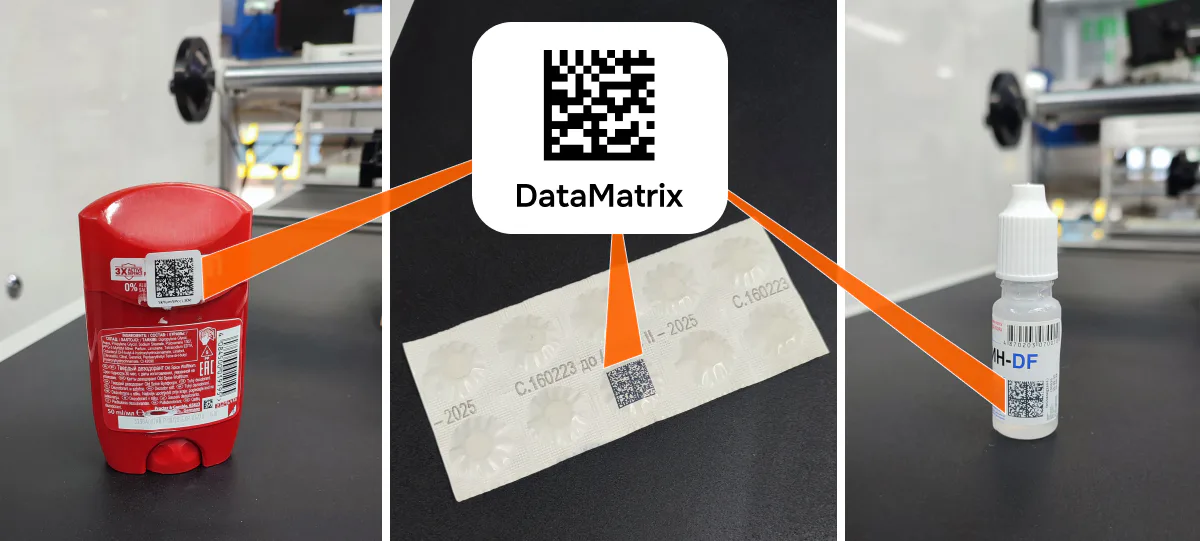
In practice, this code protects you as a buyer, honest manufacturers, and the market as a whole. Let's look at how it works, what is encoded inside it, and why DataMatrix was chosen for all of this rather than a QR code.
How DataMatrix Works from the Inside:
Outwardly, DataMatrix looks modest: a small square made up of black and white cells. But inside there is a strict architecture, each part of which performs its own task.
The first thing that catches your eye is a solid L-shaped frame along the left and bottom sides of the code. This is the finder pattern — the "search pattern". It is precisely by it that the scanner determines where the code begins and which way it is rotated. Thanks to the L-shaped frame, the code can be scanned from almost any angle, and the camera will understand where the top is and where the bottom is.
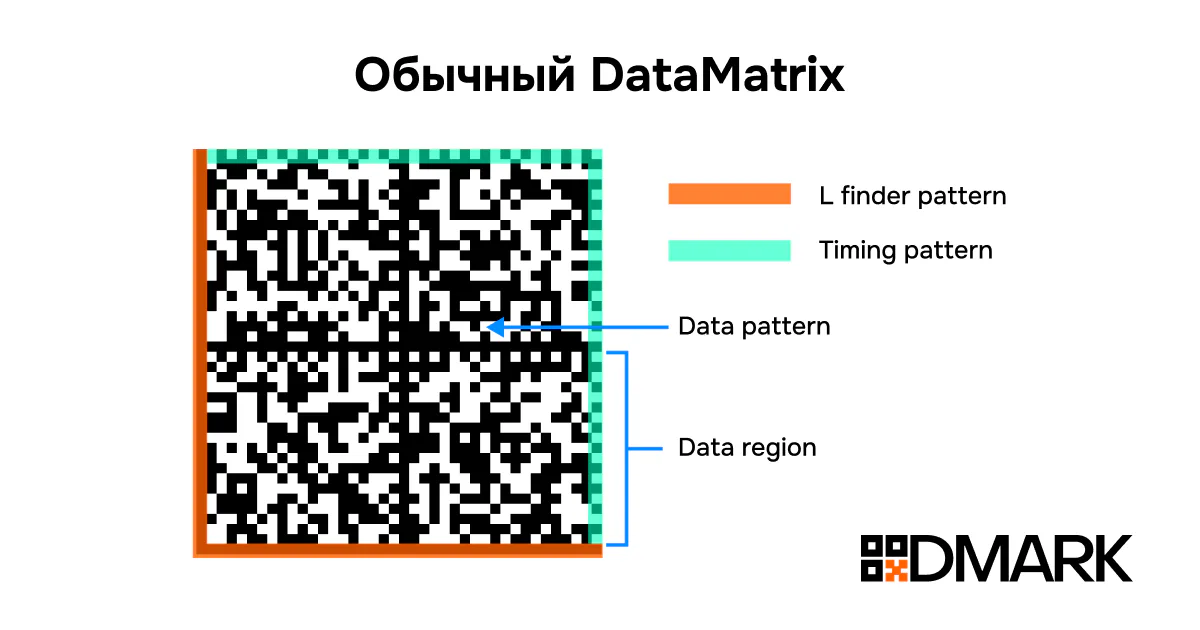
The second element is an alternating border of black and white cells along the other two sides (top and right). This is the timing pattern — the "sync pattern." It is needed so the scanner can precisely determine the grid size: how many rows and columns are in the code. Without this alternating sequence, the scanner will not be able to figure out where some data ends and others begin.
But what lies between these borders is the data itself: black and white modules (cells) that encode information in binary form. Each module is a zero or a one, just like in an ordinary computer. Together they form a compact two-dimensional matrix.
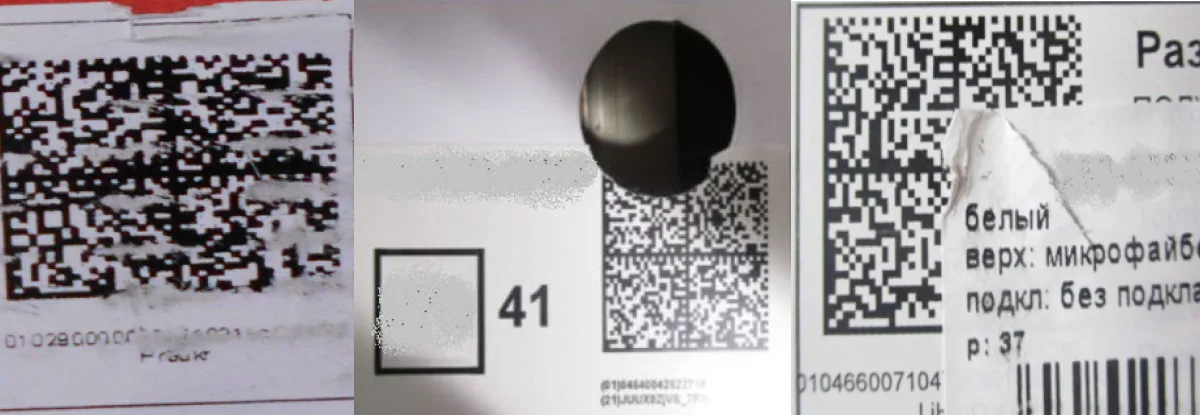
Another distinct topic with DataMatrix is its protection against damage. DataMatrix uses the Reed-Solomon error correction algorithm. To explain it without formulas: additional check bytes are written into the code alongside the payload data. They make it possible to restore the information even if part of the code is physically damaged: scuffed, peeled off, or soiled. The ECC 200 version, which is used everywhere, is capable of restoring data when up to 30% of the code's area is damaged. For goods that pass through dozens of hands and several warehouses, this is simply essential.
What Is Actually Encoded in the Marking Code
This is where things get really interesting. Because a DataMatrix code on the packaging of a medicine or a pack of cigarettes is a full-fledged dossier on a specific unit of the product.
Let's take a pack of cigarettes as an example. The ordinary barcode (EAN-13), which has been sitting on store shelves for decades, gives the checkout register this information: "I am this product, with this SKU, at this price." At the same time, the code is the same on every pack of the same brand. One pack from a particular company is indistinguishable from another at the checkout — the codes are identical.
At minimum, three things are encoded in the marking code:
First: GTIN (Global Trade Item Number), the global trade item number. It tells the system that these are specifically cigarettes of this particular brand, this particular pack, and this particular format.
Second: the unique serial number of a specific unit. Here is the key difference from an ordinary barcode: every pack of cigarettes, every bottle of medicine, every pair of shoes has its own unique, one-of-a-kind serial number. Even if two packs are standing side by side on a shelf, identical on the outside, their marking codes will still be different.
Third: the crypto tail. This is a special encrypted block that cannot be generated on your own. It is tied to the state marking server: the code is issued by the system operator (in Kazakhstan, this is "Tanba"), and every time it is scanned, the system verifies its authenticity. Attempting to copy the code and print it on counterfeit packaging is pointless: during verification, the system will show that this serial number is already registered to another product, or that the packaging being checked does not match the original.
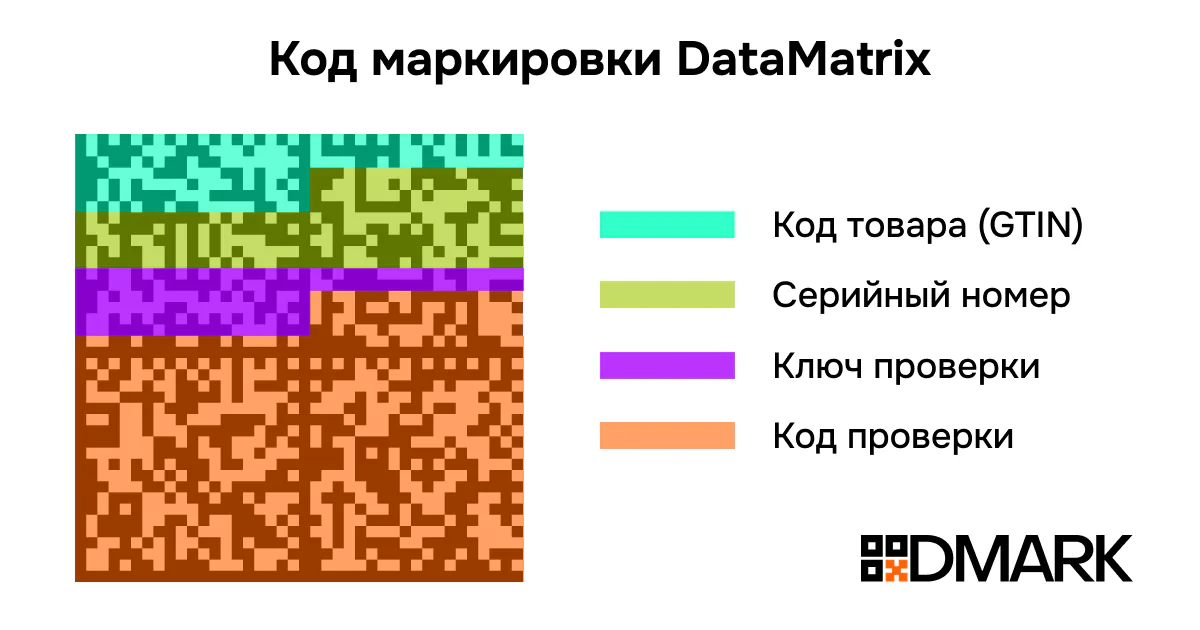
"Every product unit with a DataMatrix has its own unique number, just like a car has a plate number. There may be a thousand identical white Camrys, but each one has its own license plate. It's the same here: a thousand identical packs of cigarettes, and each one has its own marking code."
Why DataMatrix outperformed the QR code in this race
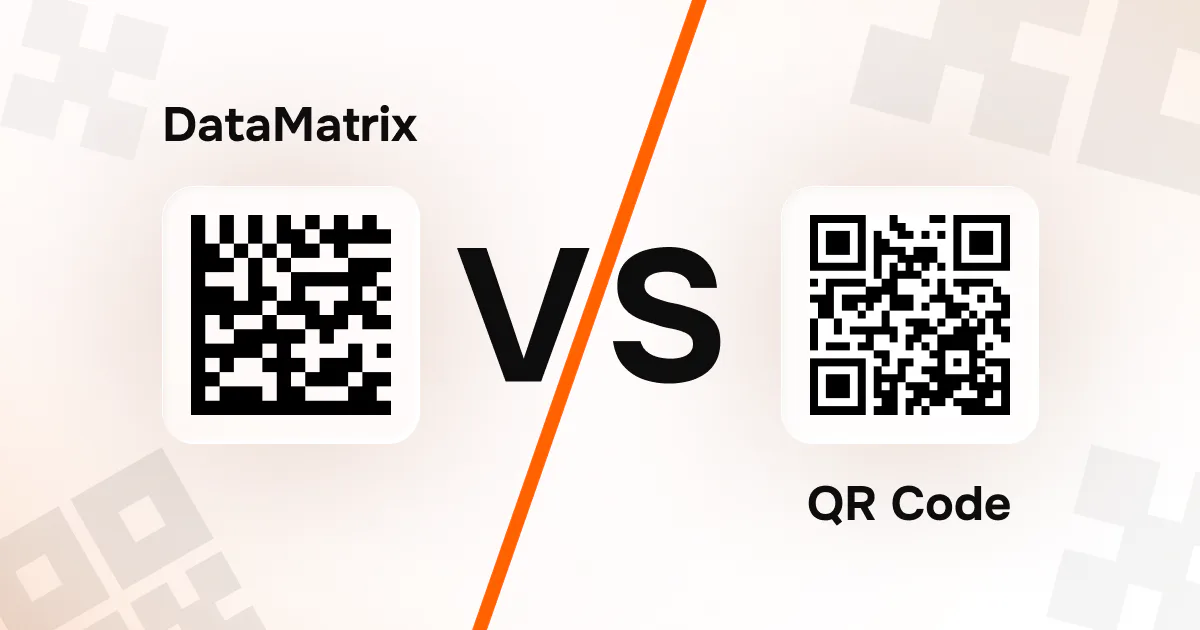
A logical question. After all, the QR code is already everywhere — on every second restaurant menu, on every Kaspi terminal. Why not use it for product labeling? In fact, when choosing a format for national labeling systems, four options were tested: the QR code, the classic linear barcode, RFID tags, and DataMatrix. And by a combination of parameters, it was the last one that won. Here's why:
Compactness. DataMatrix holds approximately the same amount of data as QR, but in a smaller area. A 12×12 mm code easily fits on a medicine label, a jewelry tag, a toy box—where there is literally no space on the packaging. A QR code for the same data would require significantly more space.
Resistance to damage. On production lines, labels pass through conveyors, rollers, and packaging machines. The code gets scratched, smudged, and partially worn off. Thanks to its L-shaped frame and error correction algorithm, DataMatrix can still be read even with serious damage. A QR code with three corner marker squares is less resistant to edge trimming.
Application cost. Product marking requires applying millions of codes per day — on every pack, every blister, every pair of shoes. DataMatrix is simpler and cheaper to print on production lines, and it is compatible with industrial printers and laser markers. RFID tags, incidentally, would cost significantly more, which across millions of units translates into enormous expenses.
And reading reliability. A DataMatrix can be read at a contrast of just 20% — even a faint, barely visible print on light-colored packaging is still recognized. A linear barcode can no longer be scanned in such a situation.
The Industry That Grew Around a Single Code
DataMatrix is no longer just a technology — it is an entire ecosystem. The standard is defined by the international organization GS1, which, as you remember from the first article, manages the system of ordinary barcodes around the world in exactly the same way. GS1 sets the rules: exactly how data must be encoded, which identifiers to use, and how the code must interact with accounting systems. Thanks to this, a code printed in Kazakhstan can be read by a scanner in Germany, and a system in Japan understands the data structure from Brazil.
A large-scale process is unfolding around the world: one country after another is introducing mandatory product labeling based on DataMatrix. In the European Union, the European Medicines Verification System (EMVS) has been in operation since 2019, under which every pack of a prescription medicine in the EU carries a DataMatrix with a serial number. In Russia, the Honest Sign system has been in place since 2019. Their labeling covers tobacco, footwear, medicines, dairy products, tires, clothing and other product categories. China, India and Saudi Arabia have their own national systems, but the technological foundation is the same: DataMatrix.
What do all these systems have in common? The goal is the same: to make every unit of goods on the market "transparent" for the state and the buyer. Counterfeiting, grey imports, tax evasion—all of this becomes harder when every product carries a unique identifier linked to a state database.
How does this work in Kazakhstan? The Tañba system
In Kazakhstan, the national system of marking and traceability of goods is called Tañba. Kazakhtelecom JSC was officially designated as the sole marking operator by a government resolution. In practice, the system is being developed by its subsidiary, the Center for the Development of the Digital Economy LLP.
The list of goods subject to mandatory labeling in Kazakhstan grows in waves; almost every quarter something new is added to the list. Today, tobacco products, footwear, and certain categories of light industry are subject to labeling, and recently beer and beer beverages, motor oils, and technical fluids were added to the list. Another recent example is biologically active supplements (BASs): their mandatory labeling also started very recently. Next in line are household chemicals, cosmetics, medical devices, and vegetable oil: pilot projects are already underway for them, which means they will be added to the mandatory list in the near future.
If you produce or sell something from the categories that are already subject to labeling, or from those that are about to be added to it, the process looks roughly like this.
First: registration in the Tañba system: the business creates a personal account, links the company's details, and confirms exactly which product items it plans to mark. Next comes the process of ordering codes: through the same account, a batch of unique DataMatrix codes is requested for the required volume of goods. The system generates the codes and issues them for payment — and yes, each code costs money; it is a separate line item in the product cost that the business has to factor into its plan.
Next: the most "physical" part: applying codes to packaging. The options vary here, from a simple label printer for small-scale production to an industrial laser marker integrated directly into the conveyor line. Each applied code must be confirmed in the system as "issued", that is, to report that this particular code actually landed on this particular unit of goods.
From this moment on, the product lives in the system: every movement — from the manufacturer's warehouse to the wholesaler, from the wholesaler to retail, between branches — must be accompanied by an electronic invoice linked to the marking codes. This is not a box-ticking formality: if the invoice is not processed on time or is processed with an error, the product may get "stuck" in the system, and the cash register at the final point of sale will simply refuse to sell it. That is exactly why marking today is not a one-time setup, but an ongoing process that must be built into the daily work of the accounting department and the warehouse.
The final point: sale to the end customer. The cash register scans the code when the receipt is issued, and the system records that this unit of goods has been "removed" from circulation, meaning it can no longer be sold again or moved. If the goods are returned, the reverse operation takes place: "return to circulation."
Law: Mandatory Labeling for the Listed Product Groups
There is a point that many entrepreneurs miss: marking is not a recommendation or a pilot project. For the listed product groups in Kazakhstan, it is mandatory, and starting from 2026, specific administrative liability is provided for violations.
Thus, if a seller does not reflect the means of identification (marking code) in the KKM receipt, a warning is issued for the first violation, and for a repeat violation within a year: the fine for small businesses is 20 MRP, for medium-sized businesses — 30 MRP, for large ones — 40 MRP. For excise goods such as alcohol and tobacco, the rules are stricter: circulation without excise stamps or accounting and control stamps can cost 500 MRP for large businesses, along with confiscation of the batch of goods and even revocation of the license.
Essentially, for a business this means one thing: if your product falls under the list of goods subject to labelling, it is not enough to simply "know about labelling" — you need to integrate into the system entirely. Register, learn how to order codes, set up the process for applying them, and ensure that electronic waybills are transmitted with every movement of the goods. It sounds like a headache, but in practice, once the process is up and running, it takes no more time than the usual work with ordinary waybills.
In Conclusion
A DataMatrix on packaging is not just a picture for a scanner. It is: a state database, a verification system, an anti-counterfeiting tool, a tax control instrument, and a guarantee for the buyer — and all of that in a single black-and-white square.
For businesses in Kazakhstan, marking is no longer just a question of "do we need this" – it is part of the rules of the game in the market. And the sooner a company builds the process, the less stress there will be when its product category officially enters the list of mandatory marking.
We at dmark.kz help companies go through this journey from start to finish: from registration in the Tañba system to setting up equipment and automating code application right on the production line. If you are reading this article and thinking, "should my business already be marking?" write or call us, and we will figure it out together.