
Rejection Camera on the Line: Three Types of Cameras and How They Differ
A code reader and a machine vision system are different devices, even though they look similar. We break down what types of cameras exist, how they really differ, and how to avoid overpaying for extras or ending up without the control you need.
The batch left the line for the market. Codes applied, invoices processed, everything looks in order. A week later the wholesaler calls: half the boxes fail acceptance — the scanner at their warehouse refuses to read the marking. Or another scenario, no less unpleasant: the codes read perfectly, but every third box has a loose lid, and complaints are already coming in from retail.
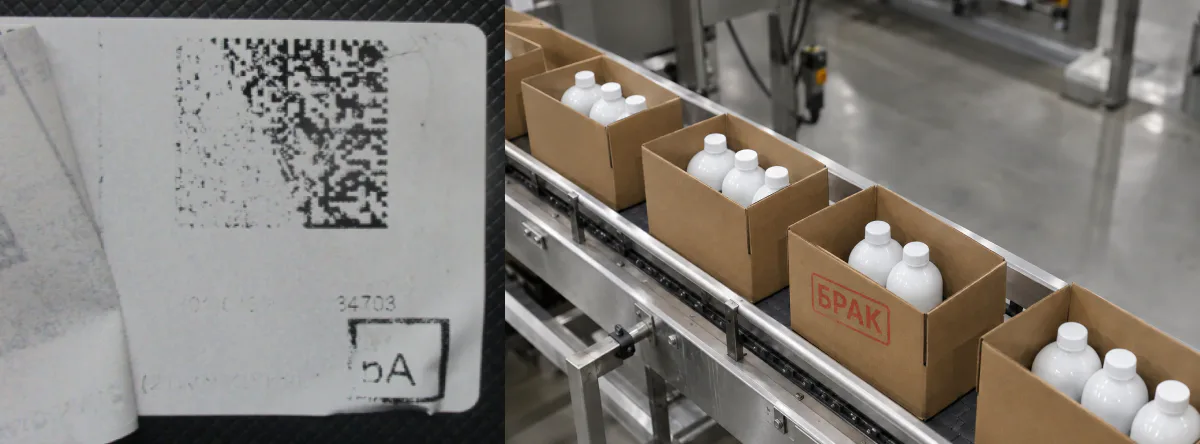
In both cases the cost of an error is the same: returns, misgrades, disputes, money. You needed to catch it right on the line, at the very second the product passed under the camera. That is exactly what a rejection camera exists for. The confusion begins when the time comes to choose one: there are several types of cameras, they look alike, but they can do very different things. Buying the wrong one means either overpaying for functionality you will never use, or discovering halfway through implementation that the camera never promised the inspection you need.
What such a camera should be able to do
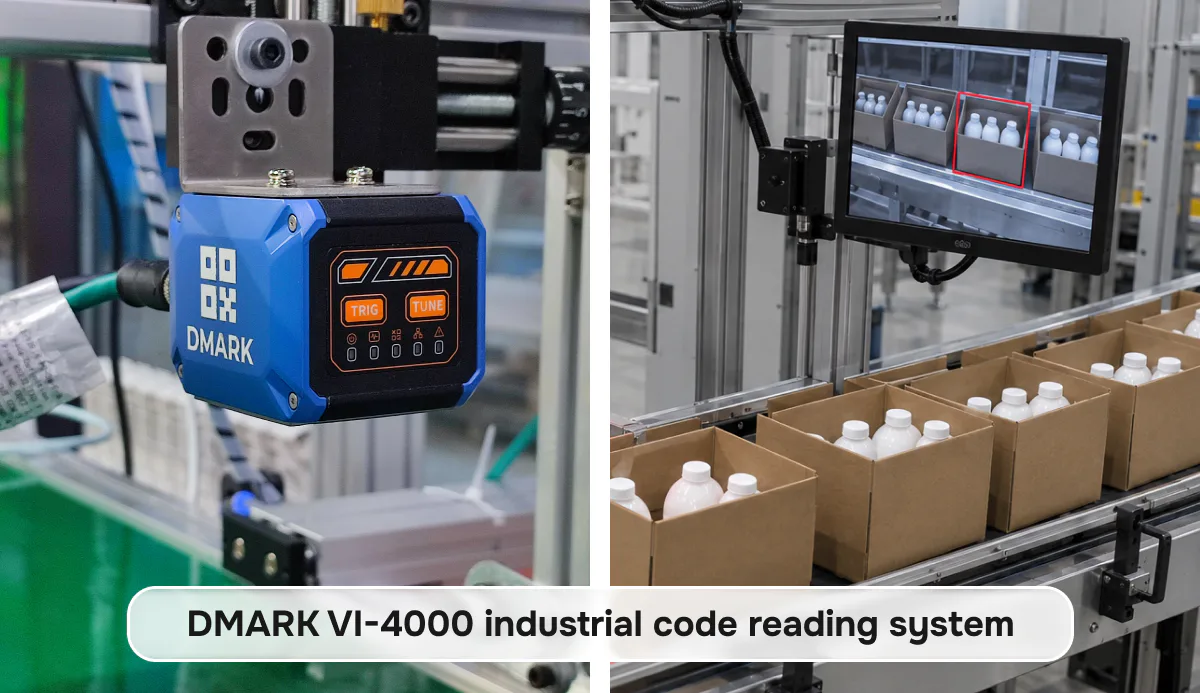
The chain is short and always the same. The sensor sees that the part has arrived at the working point. The camera takes a snapshot. In a fraction of a second, the algorithm analyses the image and issues a verdict: good or reject. And immediately a signal goes out: to the pusher, to the line stop, to the tracking system.
This is where the key difference from a conventional video surveillance camera lies. That one records an image, while a person watches and decides. Here, no one is watching: the camera makes the decision on its own, at line speed. That is why the requirements are different too — not "so that it can be seen," but "so that a decision is made, and exactly the right one."
What the camera sees: just the code or the entire product
Here all three models split into two camps, and this is probably the main thing to understand before diving into complex specifications
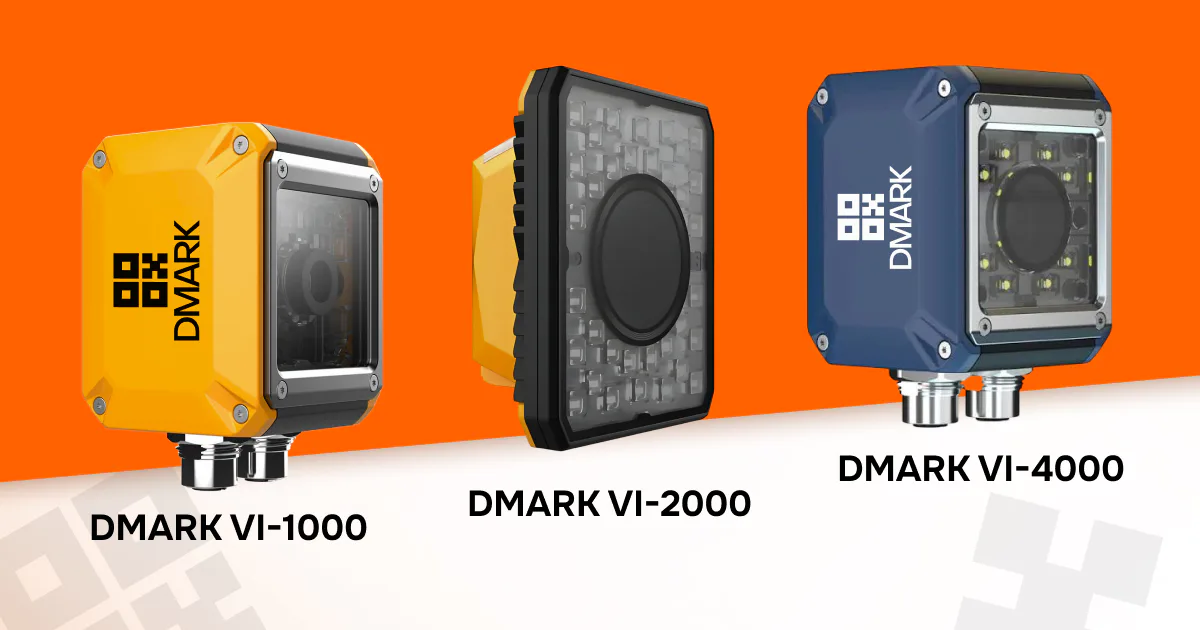
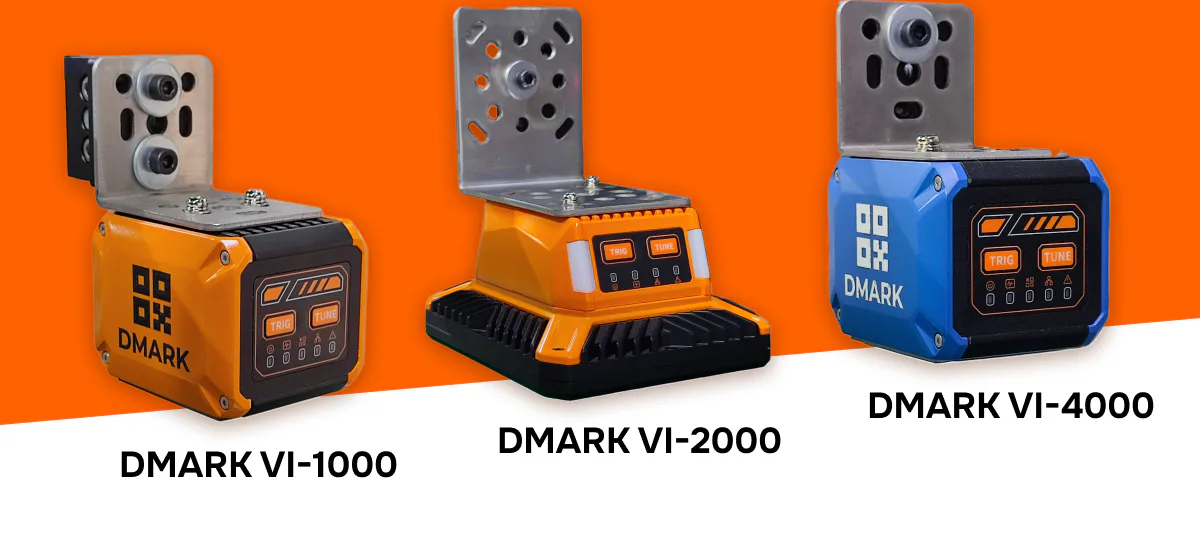
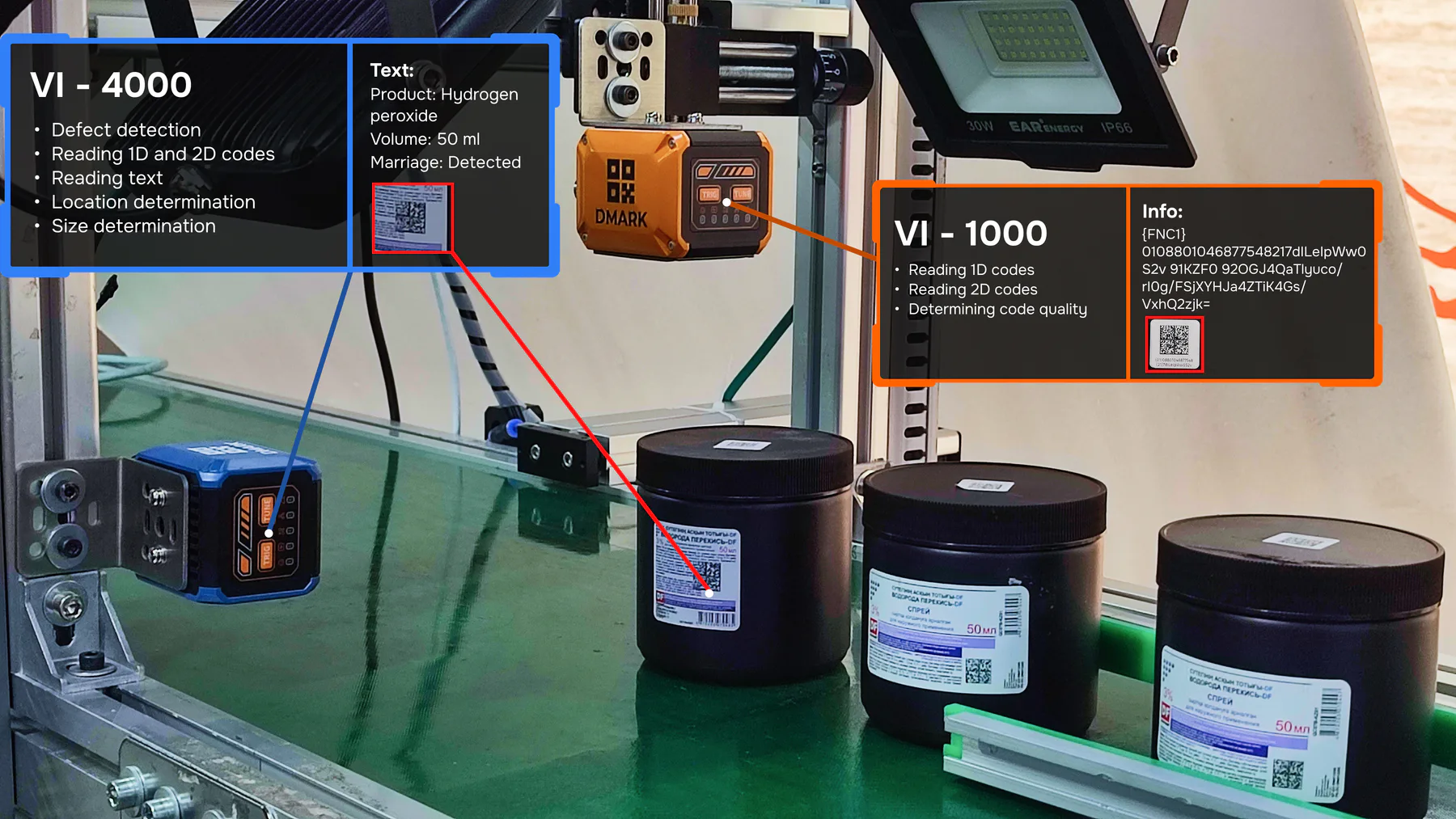
DMARK VI-1000 and VI-2000 are code readers. They do not care what the product looks like: dented, clean, sitting crooked, or half assembled. Their one task is to find the code and read it, even if it has been applied poorly. They are narrow specialists, and within their narrow task they outperform a universal solution.
DMARK VI-4000 is a machine vision system. It looks at the product as a whole: whether there is a dent, whether all parts are in place, whether the part has seated correctly in the fixture, whether the label is applied straight. On top of that, it reads text and numbers from the packaging: serial numbers, dates, batch numbers, and it also works with codes.
The difference is easier to show with an example. If the task is: "there is a code on the bottle, and it reads," you don't need to buy a machine vision system: there is nothing here but the code itself, and a reader will handle it faster and cheaper.
Another case: checking that the cap is screwed on tight, the label is applied straight, the box contains the complete kit, and at the same time reading the marking code. A single reader will not be enough here, because it physically sees nothing but the code. You need a VI-4000.
"Reading a code and understanding what is in the image are two different tasks. The first is done by a reader, the second only by a machine vision system."
How much the camera sees at once
VI-1000 and VI-2000 read codes equally well. What sets them apart from each other is, first and foremost, their field of view.
VI-1000 works like a magnifying glass. The area it covers is measured in centimeters, and the working distance is just a few tens of millimeters: for the reference device on which the model is based, it is around 30–125 mm depending on the lens. On the other hand, the image is dense and the speed is high: a benchmark of around 60 reads per second. This is a workhorse for a line where the code is always in one place, the item is small, and the camera is mounted close.
VI-2000 is a different view: wide and from above. A resolution of up to 20 MP and a large field of view make it possible to capture an entire box or pallet in a single frame and pull several codes out of it at once. Working distance: up to a couple of meters: the reference unit is rated at up to 2000 mm, and at that distance wide-angle optics capture more than a meter horizontally: approximately 1.7 × 1.4 m for an 8-mm lens. Instead of reading twelve boxes one by one, the camera captures the entire layer in a single pass.
There is a simple rule between them. A small item, one code, camera nearby → VI-1000. Large packaging, several codes in the frame, or nowhere to physically bring the camera close → VI-2000. One code, but on a large box and far away: also VI-2000.
And what about AI - what do algorithms have to do with it
Today the word "AI" gets slapped onto just about everything, so it is worth explaining exactly what it means in this camera. We are talking about two different ways in which the program makes a decision.
The first is a rigid algorithm. It looks for exactly what the engineers programmed into it: contrast no lower than a set value, the code no closer than so many millimeters to the edge, deviation from the reference no greater than a threshold. As long as the situation falls within those bounds, it works flawlessly. But let something appear that it was never taught about, and it will either let a defect through or bring the line down with false triggers.
The second is a trainable model. It is not told in words what a defect looks like. It is shown examples: here are a dozen samples with a dent, here are a dozen normal ones. After that, it finds the common ground on its own and begins to recognize similar things. This is deep learning in the simple sense — not magic, but a persistent comparison of examples.
Why this is needed in practice. There are defects that are almost impossible to describe in words in advance: “some dent of an unclear shape,” “a scratch, but not everywhere,” “the label looks straight, but something is off.” A rigid algorithm is powerless here, because it needs a clear criterion. A trainable model copes because it has seen something similar.
In the DMARK VI-4000 both approaches work together, and it is the trainable model that is responsible for classifying "good/defect" by appearance. Training runs on a small number of samples of your product, and there is no need to program anything for it. The VI-1000 and VI-2000 readers follow a different logic: there, image processing algorithms matter more, as they pull the code out of a poor image.
Difficult cases - when the code is fundamentally hard to read
A separate conversation is when situations arise where the code exists but is hard to make out with the naked eye. Engraving directly on metal, what is called DPM: the code is not printed on a label but etched onto the part itself. Or a curved shiny surface where glare eats up half the modules. Or simply smudged printing that has already been scratched on the conveyor.
Let's be blunt: there is no universal camera that works "for every case." But for these tasks, readers look more convincing. The VI-1000 and VI-2000 are designed for challenging reading conditions: low contrast, curvature, reflections, engraving on the part; the reference devices they are built on are specified for work with DPM marking and more than fifty types of surfaces. The VI-4000 can also read text and codes, but its strength lies not in that, but in analyzing the image as a whole.
If your case is exactly that — engraving, metal, a curved surface — you shouldn't choose based on a description. It's better to bring samples and see how the camera reads them in real life: the specific lighting mode and algorithms are selected for your material.
How it connects to the line
Briefly, without diving into protocols: the camera does not work on its own. It receives a signal from a sensor: 'part in place' — takes a picture, makes a decision and passes it on: to the pusher that ejects rejects, to the line stop, or to the accounting system. All three models can work in such a chain, where they have discrete inputs and outputs for sensors and actuators and standard industrial interfaces such as Modbus or Profinet. Differences lie in the details of integration: what signals your line expects, where the report goes, how the camera fits into the existing conveyor. This is discussed individually for a specific line and is not settled on paper in advance.
How to Choose - A Simple Cheat Sheet
Start with the simplest question: do you need any inspection at all beyond the code itself. If not, then it is a reader, and choosing between the two models is as easy as it gets: the VI-1000 when the item is small, the code is always in roughly the same place, and the camera is mounted close; the VI-2000 when the packaging is large, there are several codes in the frame, or there is physically nowhere to bring the camera up close. The difference here is not in functionality, but in the size of the frame and the distance at which the camera works.
It's a completely different story when you need the code not for its own sake. A box with a product: check that the lid is screwed on, the label sits straight, the kit is complete, the part has seated correctly in the fixture, and at the same time read the marking. Or the serial number and the production date, which need to be verified against the batch job order. Here you can't do without the VI-4000, and it pays for itself in one case: when visual inspection is a regular task on the line, not a one-off check "just in case." It is trained on samples of your products, so the more typical defects you show it at the start, the less noise and fewer false triggers there will be later.
And separately, complex marking: engraving on metal, a bent or reflective surface, faint printing. Here there will be no answer on paper: bring your samples, and we'll see which model and which setup can handle your material.
At DMARK we don't start with a catalog, but with an audit of your production facility: what is already installed, what works, and where the line lets defective products through. If the existing equipment can handle the job, we use it; if it can be upgraded, we upgrade it; and only if a section is genuinely missing do we select a camera: VI-1000, VI-2000, or VI-4000.
We don't change your production process. Quality control must fit into it neatly, without stopping the line and without unnecessary rework. From compact solutions to high-capacity lines, because every enterprise has its own scale and its own constraints.
Not sure which camera you need?
Bring your samples — we'll look at what the camera sees on them, and from there we'll move toward a specific configuration.